Hindustan Ambassador
Out with the old, and in with the...old!



The first time I travelled to India was 39 years ago – I confirmed that the other day with an old friend I’d recruited in Bombay for the advertising agency I was then employed by. Where did THAT time go?
Anyway, the recruitment agent I was using at then picked me up from whatever Bombay Airport is called now, in a black Hindustan Ambassador, and it immediately transported me back to my childhood! The sounds, dimensions, trim and smell of the leather inside the car triggered memories of short trousers, jaggy jumpers, Cub Scout activities and above all, the heady aroma of vinegar-soaked chips! We always had chips after Cubs, and if my Dad wasn’t collecting us from the meeting, my pal Brian Clark’s Dad was, in his Morris Oxford Series 3 – the very car that became the Hindustan Ambassador.
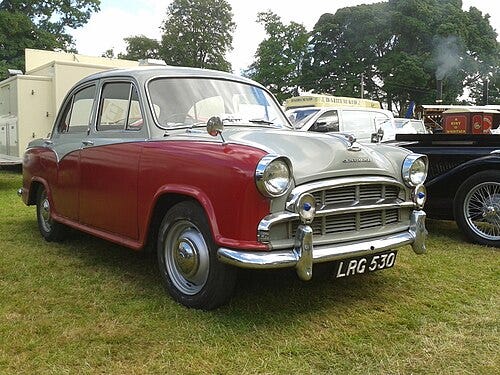
Brian Clark’s Dad’s Morris Oxford - exactly like this! (picture from Wikipedia Common files)
The Dads took it week about in an unwritten rota to collect us – our Mini Countryman (Road & Scale issue soon!) with the back seats folded, or Brian’s Dad’s red and grey Morris Oxford. I think Brian’s Dad was a bank manager, which would account for the car: staid, distinguished, reliable, old school - horses for courses, probably.
Flash forward 20 years from that first blast of memories, and I found myself behind the wheel of a white Ambassador, with the obligatory blacked-out windows of a wannabe diplomat, in Kerala. This trip was a holiday to visit a friend and his family in Trichur (Thrissur, nowadays), the capital of the Kingdom of Cochin. The City of Celebrations was once a cultural crossing-point on the Spice Route, assimilating Assyrians, Greeks, Persians, Arabs, Romans, Portuguese, Dutch and English in a cosmopolitan melting pot that exists in Kerala to this day.
The cosmopolitan aspect was ably demonstrated during my first drive: my pal’s friend, whose father owned the behemoth, agreed to a bit of one-upmanship. He and my pal sat in the back of the car whilst I drove. We pulled into a petrol station to refuel the car, and whilst the Brit driver, got out to organise the fuel, the local boys stayed in the back of the ‘diplomatic’ car. The bewildered pump attendant almost fell over when the two locals got out to pay, and the ‘humble’ driver got back in the driving seat, in a seeming reversal of colonial fortunes!
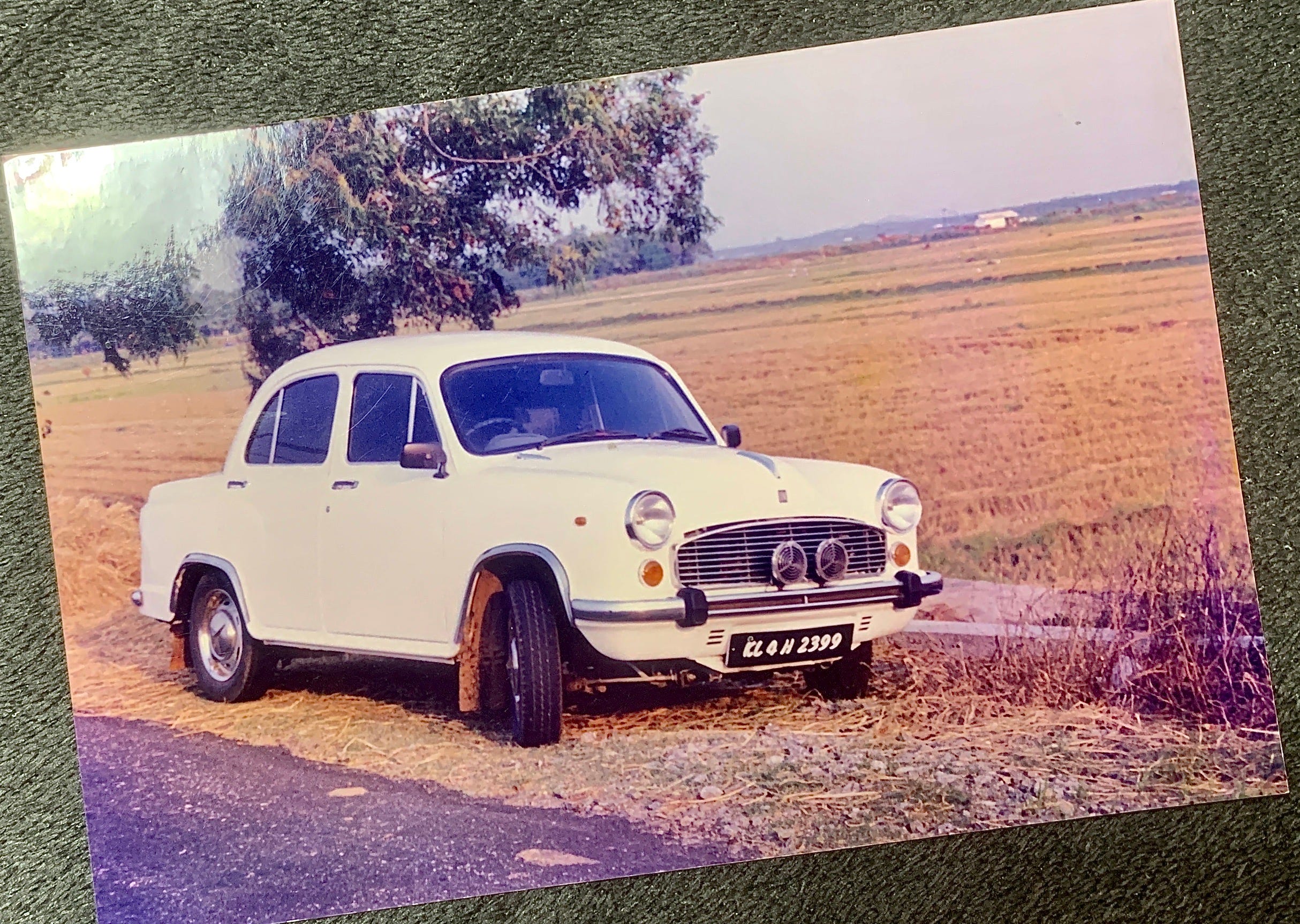
On a different trip, another pal and I ‘pinched’ the Ambassador taxi we’d hired to take us around Chennai for a few business visits. Returning to the car after lunch, we found the driver curled up and snoring in the back seat. Since the key was still in the ignition it took only speed and cunning to get the car moving before the hapless driver came to! I had forgotten how clunky the column-change gearbox was, so our getaway didn’t last very long!
The Ambi was certainly an anachronism: no other new car available anywhere still had a column-change gearbox to allow clear floorspace and therefore three-abreast seating in the front. Yet there were only two front seatbelts! The ignition was by key but the starter by a remote switch, a feature that was not to become a commonplace item again until the early 1990s. Leaf springs at the rear are now seen only on commercial vehicles and the torsion- bar setup on the front effecyively came from the Morrises of the 1930s.
Can we use the word ‘iconic’ to describe the Ambassador? I’m not sure. It was someone else’s design first, so probably not. Is it a classic? In terms of India’s automotive history, for sure, but as a classic in its own right, less so, I think. One thing is for sure, though, no one would ever mistake it for anything else, and you don’t get to apply that observation much nowadays.
A Bit of Background
Hindustan Motors, a subsidiary of the Birla Group, one of India’s largest industrial conglomerates, bought the rights and tooling for the Morris Oxford Series 3 from the British Motor Corporation (BMC) in 1956. BMC had already entered collaboration with Italian styling house Pininfarina and was producing the first of what was to become a badge-engineered series of family cars, starting with a Wolseley and encompassing the Series 3 Oxford replacement, a new Austin Cambridge plus Riley and MG derivatives.
The en)tie Series 3 Oxford facility - presses, jigs, assembly lines, mills...everything -was shipped to Uttarpara, north of Kolkata in West Bengal. The first-generation Hindustan Ambassadors started rolling out of the Hooghly plant in 1957 and remained unchanged for six years. The face-lifted Mark II model ran even longer, with only minor tweaks between November 1963 and June 1975, and it is this model that is now considered the benchmark. Even today, 12 years after production ceased, it is the Mark II that one sees being restored and repaired all over India.
The Ambassador did, however, go through a number of improvements over its seven generations: engines were upgraded and swapped, diesel was introduced, grilles and trim items were modernised or made from plastic. Bumpers and sidelights, interior appointments and finishes and embellishments throughout the car came and went, but the fundamentals – shape, size, stance and presence – never really changed.
On Indian roads, the Ambassador is still a big car and in the sub-continent driving environment, that is no bad thing. Where the first rule of driving is ‘might is right’, and no-one takes on an Interstate Public Bus - or an elephant - the Ambi is a handy tool. It was the Government vehicle of choice, so generally speaking, if you are in one, especially with darkened windows, most things will move over to let you through.
Even the newer generations are not quick, and none at all were factory-fitted with automatic gearboxes, so with pretty archaic running gear any drive on other than a glass sheet is going to be bumpy: you are saved only by the seats, which resemble your grandmother’s couch in both padding and finish!
Banned at one point in its home state of West Bengal, a year after the introduction of tougher emission control standards, “The King of Indian Roads” was already becoming a relic when the centuries flipped. Falling sales, smarter, more modern competitors and financial difficulties finished off the Ambassador. In its last year of production, 2014, Hindustan Motors sold only 2,200 units, 10% of the annual sales it enjoyed in the mid-eighties.
Ambassadors in Scale
There are Morris Oxford models from Oxford Diecast in 1:76 and other railway scales, but curiously only one Series 3 car, in green, which appears to be out of stock. Series 2 and Farina variants are readily available but not the car the Ambassador was based on. Likewise, Vanguard do a Farina model and Corgi did an Austin Cambridge Driving School car, but the Morris Oxford Series 3 is poorly represented at any scale.
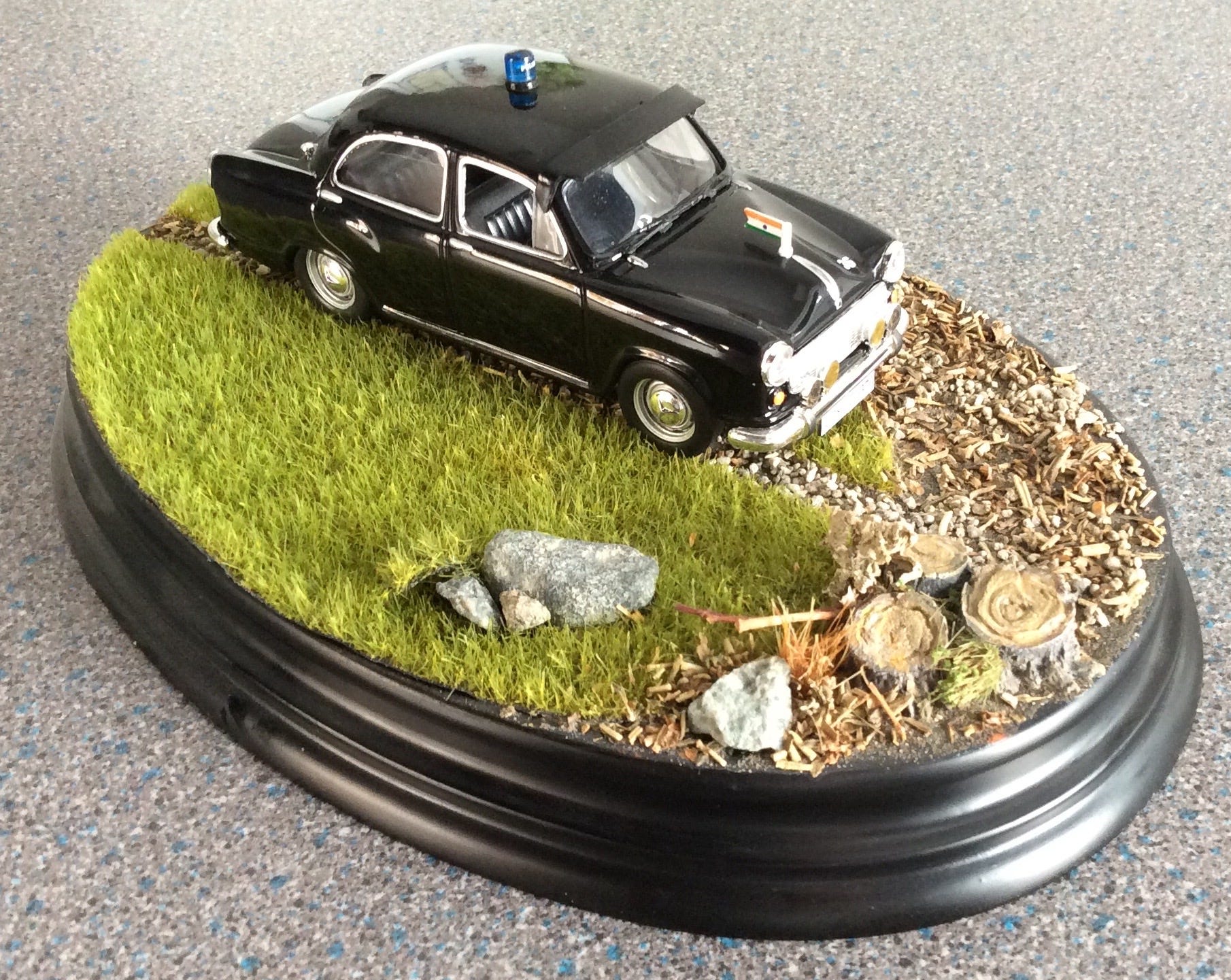
The Atlas/DeAgostini police cars, shown above, along with the standard and taxi versions from IXO at 1:43 can still be found, usually on the specialist used model listings.
The only other model I have found that is not a toy, is the Vahanam 1:18 Series I or Series II car, made in Bangladesh in pale yellow or black. These were available at the equivalent of £70 plus shipping from ScaleArts in India when I last looked, but may be sold out: beautifully made model as anything else I have from Bangladesh is, so well worth keeping an eye out for.
Atlas/DeAgostini World Police Cars – Hindustan Ambassador
I have two of these little 1:43 gems, both of which started life as the India contender for Atlas/DeAgostini’s World Police Car series, which was offered originally with a part-work magazine subscription in Italy. I bought them a while ago from a listed supplier but they are only available now on the likes of eBay. Price varies but new and pre-owned examples seem to fetch the same money – around $40 including shipping, though read the small print on that!
They are not cheap, and I certainly did not pay anything like that for mine: looking through the old files, I bought both of mine new in 2019 for $10 a piece, including shipping.
Based on an old IXO model (no markings but triangle-head screws underneath) it is nicely detailed and not bad for accuracy. The chrome’s a bit heavy-handed and the Indian flag on the bonnet is upside down, but otherwise it sits neatly on a shelf as a display piece.
I bought the second one to reverse-engineer to a Series 3 Morris Oxford, like the one I had chips in, though in a different colour scheme. The Police version remains untouched, though it does sit on a tiny diorama plinth I made up for it, as you see, representing a rural Indian location.
Code 3 Morris Oxford Series 3
First order of business on any restoration or Code3 is to get the thing apart – easy on this model as it is a screw-base. The only complication is finding a triangular-headed screwdriver.
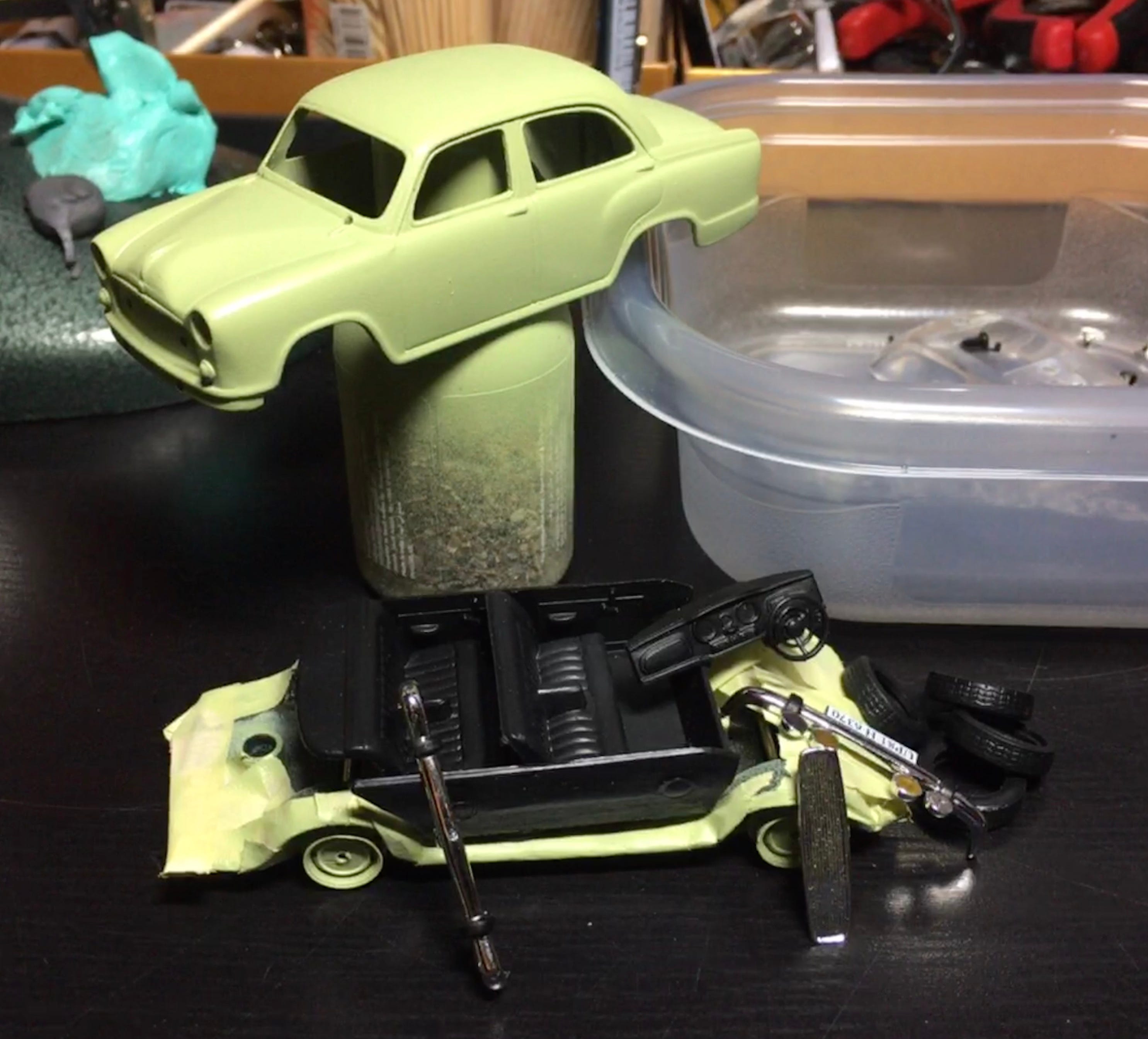
Once apart, the main components separate easily, and there is no real need to change the wheels. The six plastic-glass panels are attached beneath the roof with tiny little rivets (another IXO signature) so these need careful burring off to release the screens.
That’ll be your only issue in an otherwise simple strip and assembly. I plan to cover the conversion process - and the tedious job of masking for two-tone paint - in a separate ‘modelling tips’ article, soon!
WHAT’S NEXT?
I am planning to revisit my green ‘Oxford’ at some )me, when I clear the bench of other things. Writing this piece had memories flooding back, not only of the ‘Kerala Kapers’ but also of the Cub Scout days of sausage sizzles, camping and chips! I think I’ll do the respray in grey and red just like Brian Clark’s Dad’s old motor... I wonder if it is still around, preserved in a garage somewhere, smelling of vinegar?

However, this shouldn’t be just about me! If you have a memory of a particular car from your past, why not share it on the site? If you have a better memory than me, feel free to correct anything that’s wrong with this story!
I look forward to chatting with anyone who has similar experiences, bridging the gap between what we had and what we wish we’d kept!
See you in a fortnight!
Fraser
PS: I am rescheduling to juggle dates for a new ROAD & SCALE story in the middle and at the end of each month!